
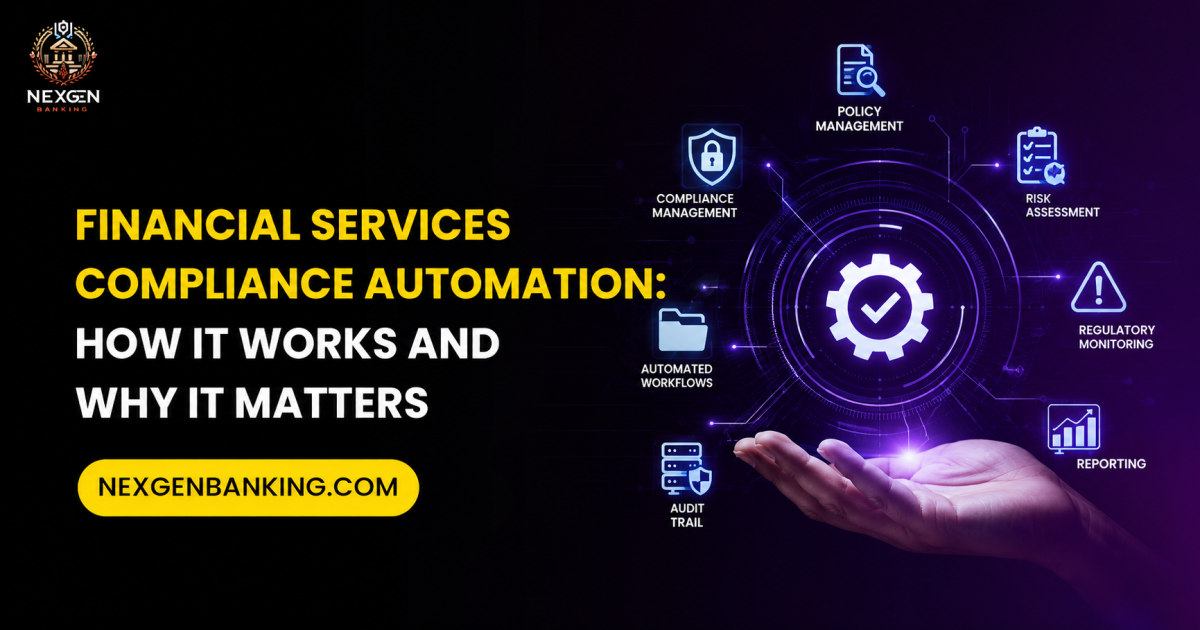
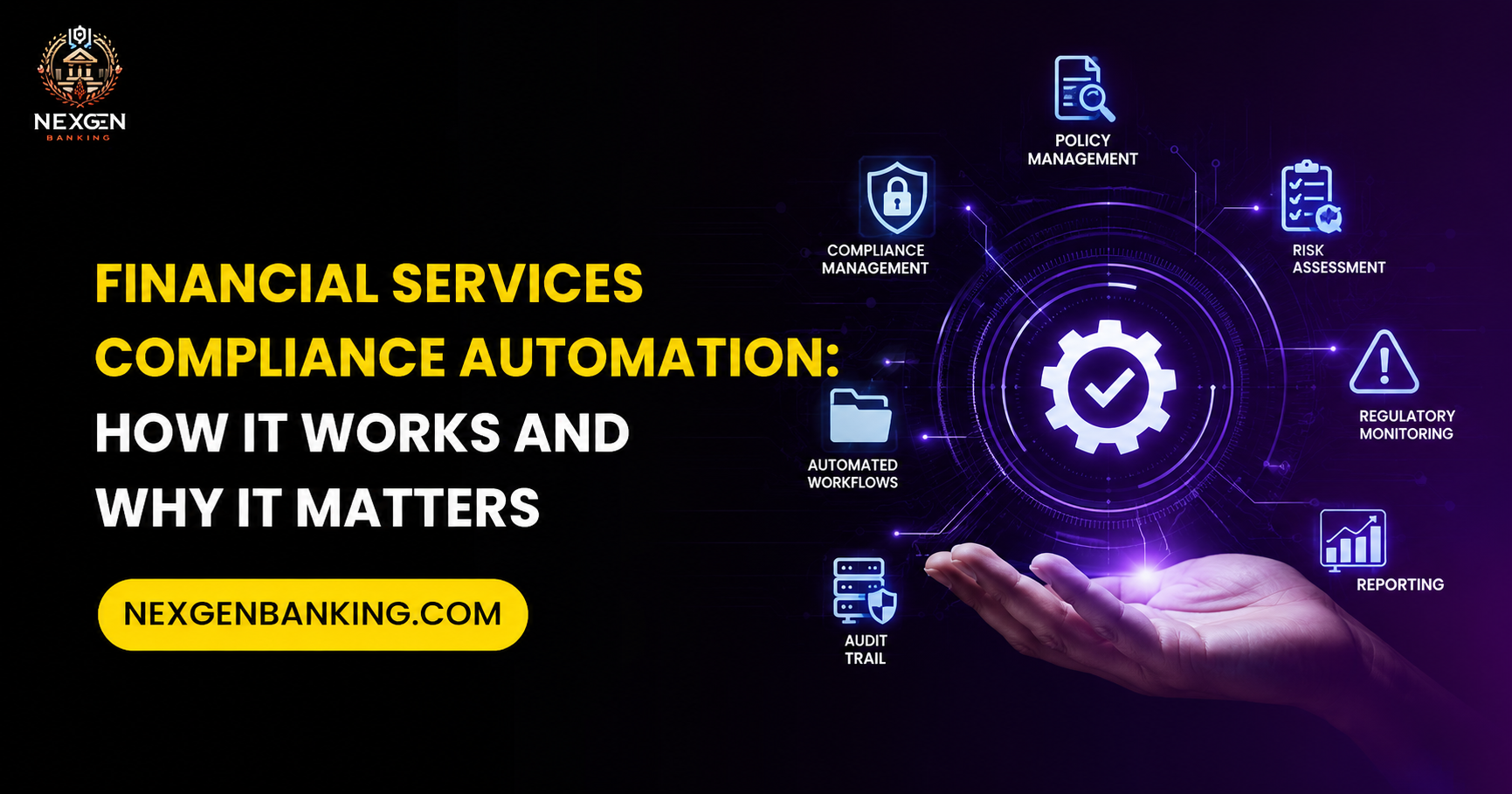
Financial Services Compliance Automation: How It Works and Why It Matters
If you work in a bank today, you already know the feeling. The rulebook keeps getting thicker, the transaction volumes keep climbing, and the compliance team keeps getting asked to do more with roughly the same headcount. Something has to give.
That pressure is exactly why financial services compliance automation has moved from a nice-to-have project to a board-level conversation. It is no longer just about saving money. It is about whether your controls can keep pace with the speed your business actually runs at.
This guide breaks down what compliance automation really is, how it works under the hood, what AI for compliance in banking adds to the picture, and why 2026 turned out to be the year most US institutions stopped experimenting and started building for real.
What Is Financial Services Compliance Automation?
Financial services compliance automation is the use of software, data pipelines, and increasingly AI models to carry out compliance work that people used to do by hand. Think customer onboarding checks, transaction monitoring, sanctions screening, regulatory reporting, policy tracking, and audit evidence collection.
The easiest way to picture it is to compare two versions of the same task. In the manual version, an analyst opens a case, pulls customer records from three different systems, checks a watchlist, copies findings into a spreadsheet, emails a manager for sign-off, and files the paperwork. In the automated version, the system gathers the data itself, applies the risk rules, scores the case, routes only the genuinely unclear ones to a human, and writes a complete, timestamped record of every step as it goes.
The human does not disappear. The human just stops spending eighty percent of the day on cases that were never going to be a problem.
Why Compliance Costs Reached a Breaking Point
The numbers explain the urgency better than any argument can.
A 2024 industry study found that 99% of financial institutions reported higher financial-crime compliance costs, with the total for US and Canadian institutions reaching $61 billion. That figure covers only financial crime. It leaves out consumer compliance, fair lending, privacy, and everything else your team is accountable for.
Then there is the headcount math. According to the Conference of State Bank Supervisors, the smallest banks spend between 11% and 15.5% of total payroll on compliance, while the largest institutions spend 6% to 10%. For a community bank, that is a serious share of the wage bill going to work that produces no revenue.
The upside of fixing this is just as well documented. BCG’s 2025 global study estimates that shifting from manual to systems-based compliance automation could generate $25 to $50 billion in annual savings from risk and compliance operating expenditure across the global banking industry, and Napier AI’s 2025-2026 AML Index forecasts that US financial institutions alone could save $23.4 billion by implementing AI-powered financial crime compliance.
Those are big, round, consultant-flavoured numbers, so treat them as direction rather than gospel. But the direction is not in dispute.
How Financial Services Compliance Automation Actually Works
Most people picture one clever piece of software. In practice, a working compliance automation setup is four layers stacked on top of each other, and it falls over if any one of them is weak.
Layer one: getting the data in one place
This is the unglamorous part that decides whether the whole thing succeeds. Customer data usually lives in the core banking system, KYC documents live somewhere else, transactions live in the payments platform, and the sanctions lists come from a vendor feed. Compliance automation starts by pulling all of that into one place with consistent formats and clear lineage, so you can always answer the question “where did this field come from?”
If your data is messy, automation will simply make bad decisions faster. Nearly every failed programme traces back to this layer.
Layer two: rules, risk scoring, and models
On top of clean data sit the rules. Some are simple and hard-coded, like flagging any wire above a threshold to a high-risk jurisdiction. Others are risk scores that weigh several factors at once like customer type, geography, product, behaviour over time.
This is also where machine learning earns its place. A rules-only system treats every customer the same way and generates enormous volumes of noise. A model learns what normal behaviour looks like for a particular customer segment and flags what genuinely deviates from it.
Layer three: continuous monitoring instead of periodic checks
Traditional compliance works in cycles. You review a customer file at onboarding, then again in three years. You test controls once a quarter. Automation lets you shift to continuous monitoring, where a customer’s risk rating updates the moment something changes and a control breach surfaces the same week it happens rather than at the next audit.
This is the single biggest practical difference between a manual programme and an automated one, and it is what regulators increasingly expect to see.
Layer four: the audit trail
Every automated action needs to leave a record i.e. what was checked, what the system decided, what evidence it used, who reviewed it, and when. Done properly, examination prep stops being a six-week fire drill and becomes a report you can run on demand.
Where AI for Compliance in Banking Is Making the Biggest Difference
AI for compliance in banking is not one capability. It shows up in a handful of specific places where the results are already measurable.
The clearest win is transaction monitoring. Legacy rules-based systems are notorious for false positives, and analysts spend their days closing alerts that were never suspicious. Banks that have deployed machine learning models for transaction monitoring report false positive reductions of 40 to 60%, with simultaneous improvements in suspicious activity detection rates of 25 to 35%. That is the rare change that makes compliance both cheaper and better at the same time.
The second area is document and language work. Customer due diligence involves reading a lot of unstructured text like incorporation documents, adverse media, & correspondence. Language models are good at summarising that material and pulling out the facts an investigator needs, which shortens case handling time considerably.
The third is regulatory change management. Rules change constantly across federal and state regulators, and keeping an internal policy library aligned with them is genuinely tedious work. AI tools can map new regulatory text against your existing policies and flag exactly which paragraphs need review.
The fourth, and newest, is agentic workflows; the systems that carry a case through several steps on their own and hand it to a human only at the decision point. This is the area regulators are watching most closely, and rightly so.
Adoption is real but still early. Wolters Kluwer’s Q1 2026 Banking Compliance AI Trend Report, based on a survey of 148 institutions, found that approximately 31.8% have deployed AI or machine learning into production, while only 12.2% describe their AI strategy as “well-defined and resourced”. The same report found that just 35.8% have established internal policies for ethical AI use. In other words, plenty of banks are building, and far fewer are governing what they build.
Why It Matters More in 2026 Than It Did in 2023
Three things changed.
First, the enforcement environment got sharper. Fenergo recorded a 417% surge in regulatory fines in the first half of 2025 compared with the same period in 2024. Whatever your view on where enforcement goes next, no compliance officer wants to be explaining a control gap that a $200,000 system would have caught.
Second, the technology stopped being experimental. Industry analysis of 2026 describes it as the year of transition from experimentation to execution, with a significant move toward deploying AI solutions in live compliance environments. Roughly 30% of banking professionals report their institutions use AI specifically for anti-money laundering compliance.
Third, budgets followed. The 2026 AscentAI Benchmark Survey found that 74% of respondents planned to invest in new compliance technology within the next 12 months, with appetite highest among fintechs at 90%, followed by Tier 1 banks at 87% and regional banks at 80%.
When four out of five regional banks are actively buying, the competitive question changes. Standing still is now a decision with consequences.
The Honest Part: What Usually Goes Wrong
Anyone selling you financial services compliance automation as a straightforward install is not being straight with you. A few patterns come up again and again.
Teams automate a broken process instead of fixing it first, and end up with a faster version of something that never worked well. Data quality gets underestimated, and the model produces confident nonsense. Model risk management gets treated as an afterthought, and then the examiner asks how the model was validated and nobody has a clean answer. And explainability gets skipped, which becomes a problem the first time a customer or a regulator asks why a particular decision was made. Wolters Kluwer found explainability and transparency to be the most acute regulatory concern among respondents at 28.4%.
The institutions that succeed tend to do the boring things first. They pick one high-volume, low-judgement process. They clean the data feeding it. They keep a human in the loop and measure whether the human’s decisions actually improve. Then they scale.
Where These Conversations Are Happening: The AI-Powered Banking Summit US
Reading about this is useful. Hearing how a peer institution handled model validation, or what their examiner actually asked, is more useful.
That is the reason the AI-Powered Banking Summit US, running 17th and 18th November 2026 in New York dedicates a substantial part of its agenda to exactly these questions. Day two includes executive panels on financial crime, AML, KYC and sanctions screening at scale, model risk management for agentic systems under SR 11-7 and BCBS principles, and AI governance, risk and compliance in the age of autonomous banking.
The speaker list runs to compliance and risk leaders from J.P. Morgan, Citi, Wells Fargo, Barclays, TD, Standard Chartered, Charles Schwab, MUFG and others. These are the people who have already made these decisions and can tell you what they would do differently. For teams building a compliance automation roadmap, that peer input is often worth more than another vendor demo.
Frequently Asked Questions
What is financial services compliance automation in simple terms?
It is using software and AI to handle compliance tasks that people used to do manually, like onboarding checks, transaction monitoring, sanctions screening, regulatory reporting, and audit evidence. The goal is not to remove compliance staff but to let them spend their time on genuine risk instead of routine paperwork.
How is AI for compliance in banking different from older rules-based systems?
Older systems follow fixed rules, so they flag anything that trips a threshold and generate a lot of noise. AI for compliance in banking learns what normal behaviour looks like for each customer segment and flags real deviations, which is why banks using machine learning for transaction monitoring report false positive reductions in the range of 40 to 60% alongside better detection rates.
Is financial services compliance automation only worth it for large banks?
No. The cost pressure is arguably worse for smaller institutions, since the smallest banks put 11% to 15.5% of total payroll into compliance versus 6% to 10% at the largest. Community banks and credit unions typically start narrow, automating one process such as customer due diligence or regulatory reporting, then expand once the data foundation is solid.
What do regulators expect when banks use AI for compliance?
They expect the same discipline they expect anywhere else: documented model validation, clear data lineage, explainable decisions, defined human oversight, and an owner accountable when something goes wrong. Explainability and transparency are currently the top regulatory concern cited by compliance leaders, so if you cannot explain a decision, treat that as the gap to close first.
Where can I learn more about compliance automation from practitioners?
Industry events are the fastest route. The AI-Powered Banking Summit US in New York on 17th and 18th November 2026 covers AML and sanctions screening at scale, model risk management for agentic systems, and AI governance in banking, with speakers from Tier 1 US and global institutions. You can request the full agenda through the NexGen Banking Summit USA website.