nexgenbanking.com

Categories
Banking

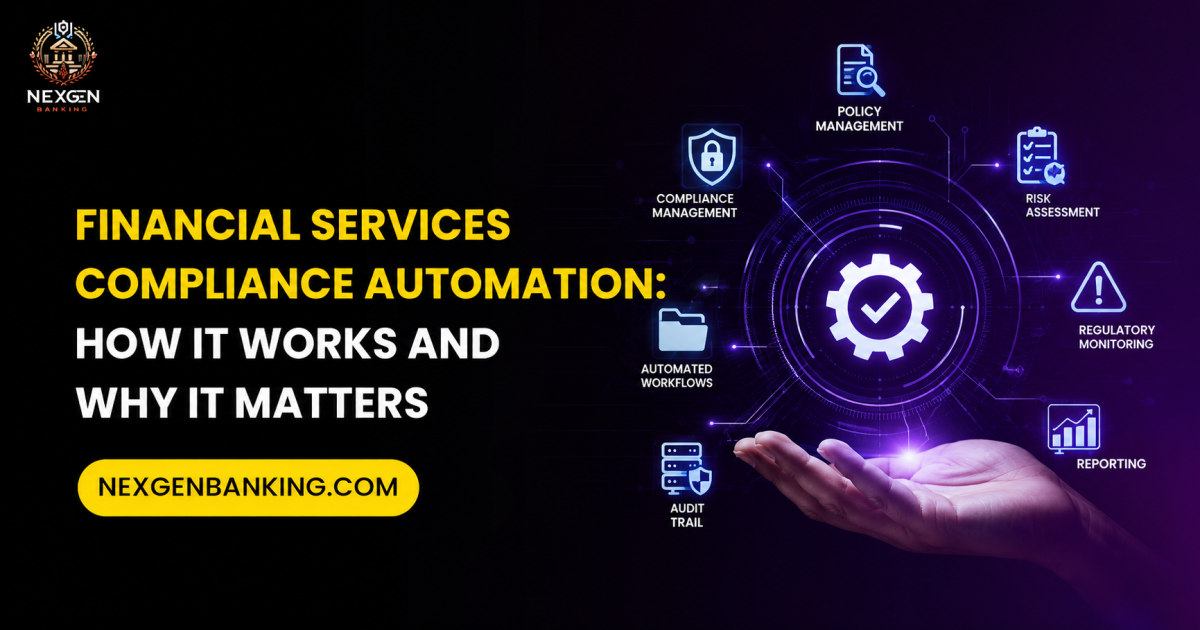
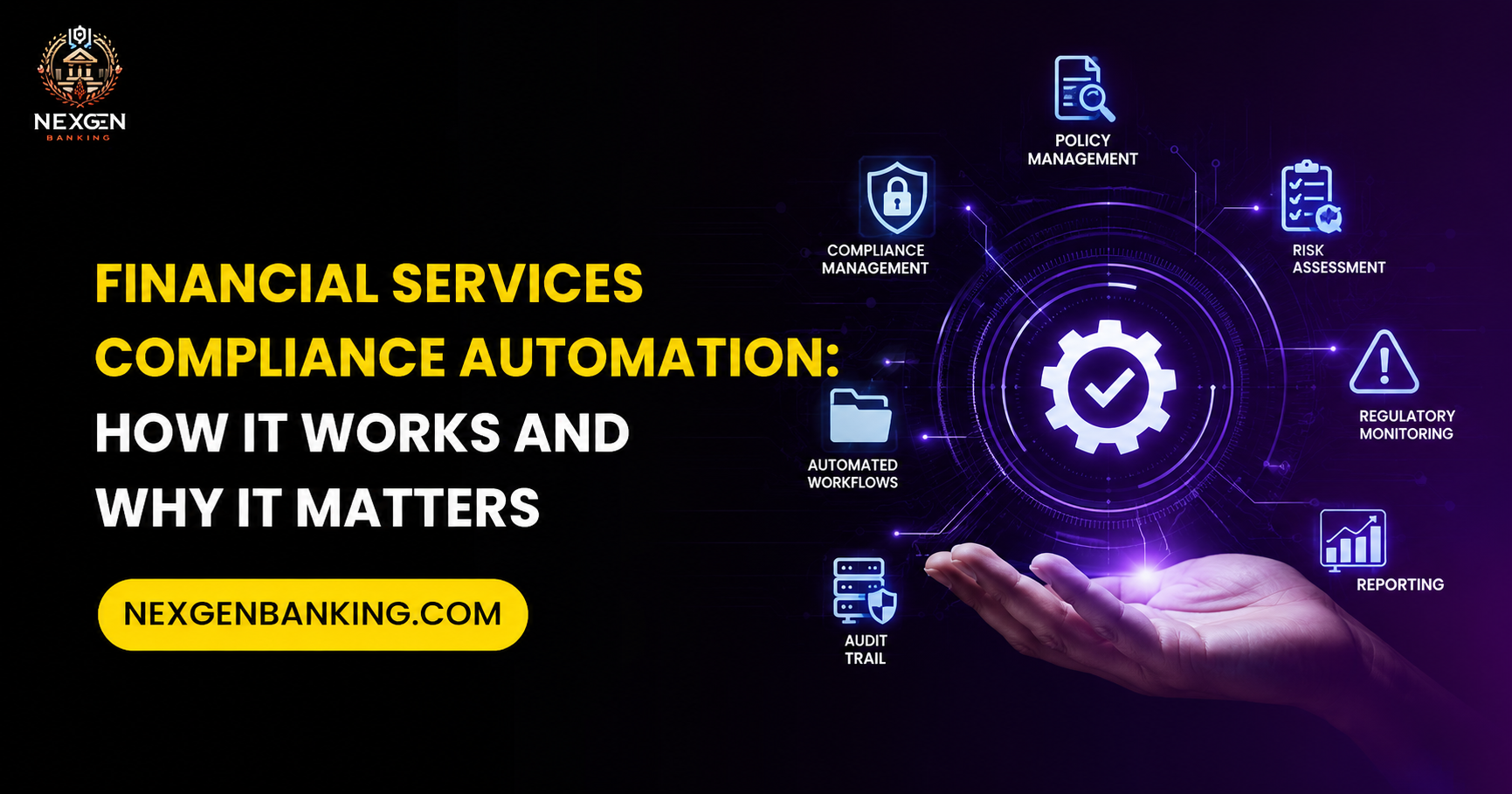
Financial Services Compliance Automation: How It Works and Why It Matters

Financial Services Compliance Automation: How It Works and Why It Matters

If you work in a bank today, you already know the feeling. The rulebook keeps getting thicker, the transaction volumes keep climbing, and the compliance team keeps getting asked to do more with roughly the same headcount. Something has to give.

That pressure is exactly why financial services compliance automation has moved from a nice-to-have project to a board-level conversation. It is no longer just about saving money. It is about whether your controls can keep pace with the speed your business actually runs at.

This guide breaks down what compliance automation really is, how it works under the hood, what AI for compliance in banking adds to the picture, and why 2026 turned out to be the year most US institutions stopped experimenting and started building for real.

What Is Financial Services Compliance Automation?

Financial services compliance automation is the use of software, data pipelines, and increasingly AI models to carry out compliance work that people used to do by hand. Think customer onboarding checks, transaction monitoring, sanctions screening, regulatory reporting, policy tracking, and audit evidence collection.


The easiest way to picture it is to compare two versions of the same task. In the manual version, an analyst opens a case, pulls customer records from three different systems, checks a watchlist, copies findings into a spreadsheet, emails a manager for sign-off, and files the paperwork. In the automated version, the system gathers the data itself, applies the risk rules, scores the case, routes only the genuinely unclear ones to a human, and writes a complete, timestamped record of every step as it goes.


The human does not disappear. The human just stops spending eighty percent of the day on cases that were never going to be a problem.

Why Compliance Costs Reached a Breaking Point

The numbers explain the urgency better than any argument can.


A 2024 industry study found that 99% of financial institutions reported higher financial-crime compliance costs, with the total for US and Canadian institutions reaching $61 billion. That figure covers only financial crime. It leaves out consumer compliance, fair lending, privacy, and everything else your team is accountable for.


Then there is the headcount math. According to the Conference of State Bank Supervisors, the smallest banks spend between 11% and 15.5% of total payroll on compliance, while the largest institutions spend 6% to 10%. For a community bank, that is a serious share of the wage bill going to work that produces no revenue.


The upside of fixing this is just as well documented. BCG’s 2025 global study estimates that shifting from manual to systems-based compliance automation could generate $25 to $50 billion in annual savings from risk and compliance operating expenditure across the global banking industry, and Napier AI’s 2025-2026 AML Index forecasts that US financial institutions alone could save $23.4 billion by implementing AI-powered financial crime compliance.


Those are big, round, consultant-flavoured numbers, so treat them as direction rather than gospel. But the direction is not in dispute.

How Financial Services Compliance Automation Actually Works

Most people picture one clever piece of software. In practice, a working compliance automation setup is four layers stacked on top of each other, and it falls over if any one of them is weak.

Layer one: getting the data in one place

This is the unglamorous part that decides whether the whole thing succeeds. Customer data usually lives in the core banking system, KYC documents live somewhere else, transactions live in the payments platform, and the sanctions lists come from a vendor feed. Compliance automation starts by pulling all of that into one place with consistent formats and clear lineage, so you can always answer the question “where did this field come from?”


If your data is messy, automation will simply make bad decisions faster. Nearly every failed programme traces back to this layer.

Layer two: rules, risk scoring, and models

On top of clean data sit the rules. Some are simple and hard-coded, like flagging any wire above a threshold to a high-risk jurisdiction. Others are risk scores that weigh several factors at once like customer type, geography, product, behaviour over time.

This is also where machine learning earns its place. A rules-only system treats every customer the same way and generates enormous volumes of noise. A model learns what normal behaviour looks like for a particular customer segment and flags what genuinely deviates from it.

Layer three: continuous monitoring instead of periodic checks

Traditional compliance works in cycles. You review a customer file at onboarding, then again in three years. You test controls once a quarter. Automation lets you shift to continuous monitoring, where a customer’s risk rating updates the moment something changes and a control breach surfaces the same week it happens rather than at the next audit.


This is the single biggest practical difference between a manual programme and an automated one, and it is what regulators increasingly expect to see.

Layer four: the audit trail

Every automated action needs to leave a record i.e. what was checked, what the system decided, what evidence it used, who reviewed it, and when. Done properly, examination prep stops being a six-week fire drill and becomes a report you can run on demand.

Where AI for Compliance in Banking Is Making the Biggest Difference

AI for compliance in banking is not one capability. It shows up in a handful of specific places where the results are already measurable.


The clearest win is transaction monitoring. Legacy rules-based systems are notorious for false positives, and analysts spend their days closing alerts that were never suspicious. Banks that have deployed machine learning models for transaction monitoring report false positive reductions of 40 to 60%, with simultaneous improvements in suspicious activity detection rates of 25 to 35%. That is the rare change that makes compliance both cheaper and better at the same time.


The second area is document and language work. Customer due diligence involves reading a lot of unstructured text like incorporation documents, adverse media, & correspondence. Language models are good at summarising that material and pulling out the facts an investigator needs, which shortens case handling time considerably.


The third is regulatory change management. Rules change constantly across federal and state regulators, and keeping an internal policy library aligned with them is genuinely tedious work. AI tools can map new regulatory text against your existing policies and flag exactly which paragraphs need review.


The fourth, and newest, is agentic workflows; the systems that carry a case through several steps on their own and hand it to a human only at the decision point. This is the area regulators are watching most closely, and rightly so.


Adoption is real but still early. Wolters Kluwer’s Q1 2026 Banking Compliance AI Trend Report, based on a survey of 148 institutions, found that approximately 31.8% have deployed AI or machine learning into production, while only 12.2% describe their AI strategy as “well-defined and resourced”. The same report found that just 35.8% have established internal policies for ethical AI use. In other words, plenty of banks are building, and far fewer are governing what they build.

Why It Matters More in 2026 Than It Did in 2023

Three things changed.


First, the enforcement environment got sharper. Fenergo recorded a 417% surge in regulatory fines in the first half of 2025 compared with the same period in 2024. Whatever your view on where enforcement goes next, no compliance officer wants to be explaining a control gap that a $200,000 system would have caught.


Second, the technology stopped being experimental. Industry analysis of 2026 describes it as the year of transition from experimentation to execution, with a significant move toward deploying AI solutions in live compliance environments. Roughly 30% of banking professionals report their institutions use AI specifically for anti-money laundering compliance.


Third, budgets followed. The 2026 AscentAI Benchmark Survey found that 74% of respondents planned to invest in new compliance technology within the next 12 months, with appetite highest among fintechs at 90%, followed by Tier 1 banks at 87% and regional banks at 80%.


When four out of five regional banks are actively buying, the competitive question changes. Standing still is now a decision with consequences.

The Honest Part: What Usually Goes Wrong

Anyone selling you financial services compliance automation as a straightforward install is not being straight with you. A few patterns come up again and again.


Teams automate a broken process instead of fixing it first, and end up with a faster version of something that never worked well. Data quality gets underestimated, and the model produces confident nonsense. Model risk management gets treated as an afterthought, and then the examiner asks how the model was validated and nobody has a clean answer. And explainability gets skipped, which becomes a problem the first time a customer or a regulator asks why a particular decision was made. Wolters Kluwer found explainability and transparency to be the most acute regulatory concern among respondents at 28.4%.


The institutions that succeed tend to do the boring things first. They pick one high-volume, low-judgement process. They clean the data feeding it. They keep a human in the loop and measure whether the human’s decisions actually improve. Then they scale.

Where These Conversations Are Happening: The AI-Powered Banking Summit US

Reading about this is useful. Hearing how a peer institution handled model validation, or what their examiner actually asked, is more useful.

That is the reason the AI-Powered Banking Summit US, running 17th and 18th November 2026 in New York dedicates a substantial part of its agenda to exactly these questions. Day two includes executive panels on financial crime, AML, KYC and sanctions screening at scale, model risk management for agentic systems under SR 11-7 and BCBS principles, and AI governance, risk and compliance in the age of autonomous banking.

The speaker list runs to compliance and risk leaders from J.P. Morgan, Citi, Wells Fargo, Barclays, TD, Standard Chartered, Charles Schwab, MUFG and others. These are the people who have already made these decisions and can tell you what they would do differently. For teams building a compliance automation roadmap, that peer input is often worth more than another vendor demo.

Frequently Asked Questions

What is financial services compliance automation in simple terms?

It is using software and AI to handle compliance tasks that people used to do manually, like onboarding checks, transaction monitoring, sanctions screening, regulatory reporting, and audit evidence. The goal is not to remove compliance staff but to let them spend their time on genuine risk instead of routine paperwork.

Older systems follow fixed rules, so they flag anything that trips a threshold and generate a lot of noise. AI for compliance in banking learns what normal behaviour looks like for each customer segment and flags real deviations, which is why banks using machine learning for transaction monitoring report false positive reductions in the range of 40 to 60% alongside better detection rates.

No. The cost pressure is arguably worse for smaller institutions, since the smallest banks put 11% to 15.5% of total payroll into compliance versus 6% to 10% at the largest. Community banks and credit unions typically start narrow, automating one process such as customer due diligence or regulatory reporting, then expand once the data foundation is solid.

They expect the same discipline they expect anywhere else: documented model validation, clear data lineage, explainable decisions, defined human oversight, and an owner accountable when something goes wrong. Explainability and transparency are currently the top regulatory concern cited by compliance leaders, so if you cannot explain a decision, treat that as the gap to close first.

Industry events are the fastest route. The AI-Powered Banking Summit US in New York on 17th and 18th November 2026 covers AML and sanctions screening at scale, model risk management for agentic systems, and AI governance in banking, with speakers from Tier 1 US and global institutions. You can request the full agenda through the NexGen Banking Summit USA website.
Categories
Banking

Future of Banking US Conference 2026: Dates, Speakers, and What to Expect

Future of Banking US Conference 2026: Dates, Speakers, and What to Expect

If you work anywhere near banking, fintech, or financial compliance, you’ve probably noticed the same headline everywhere lately: AI is changing how banks operate faster than most institutions can keep up with. That’s exactly why interest in every major event on Future of Banking US has grown so much this year. Bankers, compliance officers, and technology leaders are all trying to figure out the same thing, which tools actually matter and which ones are just hype. This guide walks you through what to expect from this year’s Future of Banking US conference, who’s likely to be in the room, and why this particular event is worth putting on your calendar.

What This Event on Future of Banking US Is All About

The NexGen Banking Summit USA is one of the more talked-about gatherings on the banking events calendar this year, and it’s built entirely around one central theme: how artificial intelligence is reshaping the banking industry from the inside out. This isn’t a generic “trends in finance” event where AI gets mentioned in passing. It’s a full event on Future of Banking US that digs specifically into how AI is being used for personalizing financial experiences, improving fraud detection, streamlining account opening, and strengthening security across banks and credit unions.


The conference is scheduled for November 17th and 18th, 2026, in the US, and it’s positioned as a two-day deep dive rather than a quick one-off session. That format matters because it gives attendees enough time to move past surface-level buzzwords and actually sit through detailed discussions, roundtables, and case studies from people who are implementing this technology right now, not just talking about it in theory.

Who's Expected to Attend and Speak

This event on Future of Banking US is built for a specific crowd. The attendee list is expected to include CXOs, VPs, directors, heads of department, managers, and specialists from across financial services, meaning it’s less about entry-level networking and more about decision-makers comparing notes on what’s actually working inside their organizations.


On the speaker and partner side, the event brings together a mix of established technology providers and emerging AI-focused companies serving the banking sector, including names like Genesys Cloud Services, Securiti, Whatfix, Cohere, Rogo Technologies, and DataSnipper, among others. These aren’t just software vendors showing up to sell products, many of them are directly involved in the discussions around AI adoption, financial data security, and regulatory technology that shape the sessions. If you’re attending specifically to hear from banking executives rather than vendors, the roundtable-style sessions tend to be where that conversation happens most directly, since they’re built around peer discussion rather than one-way presentations.

What to Expect From the Sessions

Anyone attending an advanced banking technology event US audiences are talking about this year should expect the agenda to center heavily on practical AI applications rather than abstract predictions. Expect sessions on how banks are using AI to personalize customer interactions, from tailored financial advice to smarter account recommendations, without making the experience feel robotic or impersonal.


Fraud detection is another major thread running through this kind of event. As fraud tactics get more sophisticated, banks are leaning on AI models that can flag unusual activity in real time instead of relying purely on manual review after the fact. You can expect real examples of how institutions are balancing faster fraud detection with the need to avoid flagging too many legitimate transactions, which is still one of the trickiest problems in the space.


A topic that comes up constantly at events like this, and one worth specifically watching for, is AI for compliance in banking. Compliance teams have historically been buried under manual reviews, reporting requirements, and constantly shifting regulations, and AI tools are increasingly being positioned as a way to lighten that load. Expect discussions on how AI is being used to automate parts of regulatory reporting, monitor transactions for compliance risks, and reduce the manual workload on compliance teams, while also being honest about where human oversight still has to stay firmly in the loop.

Roundtables: Where the Real Conversations Happen

One feature worth highlighting about this particular event on Future of Banking US is its roundtable format. Rather than only sitting through keynote-style presentations, attendees get pulled into smaller group discussions focused on specific challenges, like navigating AI governance, managing data security risks, or figuring out where embedded finance fits into a bank’s broader strategy. These sessions tend to be more valuable for attendees who want direct answers to problems they’re currently facing, rather than general industry commentary.


This format lines up with a broader shift happening across advanced banking technology event US programming in general. Conference organizers across the industry have been moving away from purely lecture-style agendas and toward interactive formats that let executives compare notes with peers who are solving similar problems, which tends to produce more usable takeaways than a straight presentation would.

Why This Event Matters Right Now

Banking in the US is going through a stretch where AI adoption isn’t optional anymore, it’s becoming a competitive necessity. Institutions that move too slowly risk falling behind on customer experience, fraud prevention, and operational efficiency, while those that move too fast without proper governance risk compliance and security headaches down the line. That tension is exactly what makes this event on Future of Banking US so relevant this year. It’s not just about learning what AI can do, it’s about understanding how to implement it responsibly, especially when it comes to sensitive areas like AI for compliance in banking, where getting it wrong can carry real regulatory consequences.

For anyone in a leadership or strategy role at a bank, credit union, or fintech company, this kind of event offers a rare chance to see how peer institutions are actually approaching these decisions, rather than relying on vendor pitches or secondhand reporting.

Final Thoughts

The Future of Banking US conference taking place on November 17th and 18th, 2026, is shaping up to be one of the more focused events on the calendar this year, specifically built around how AI is transforming banking operations, customer experience, fraud prevention, and compliance. Whether you’re attending to benchmark your own institution’s AI strategy or looking for practical guidance on AI for compliance in banking, this advanced banking technology event US professionals are watching closely is worth serious consideration for your 2026 calendar.

Frequently Asked Questions

When is the Future of Banking US conference happening in 2026?

The event is scheduled for November 17th and 18th, 2026, running as a two-day program focused on AI’s role in the banking industry.

The conference is aimed primarily at CXOs, VPs, directors, heads of department, managers, and specialists working in banking, credit unions, and fintech, particularly those involved in technology strategy, compliance, or customer experience decisions.

Expect sessions on AI-driven personalization, fraud detection, account opening automation, data security, and AI for compliance in banking, along with roundtable discussions on AI governance and embedded finance strategy.

Sessions typically cover how banks are using AI to automate regulatory reporting, monitor transactions for compliance risks, and reduce manual workload for compliance teams, while addressing where human oversight is still necessary.

While large banks and credit unions are well represented, events like this typically attract a range of financial institutions, including regional banks and fintech companies, since AI adoption challenges around compliance, fraud, and customer experience affect institutions of nearly every size.

Categories
Banking

The AI-Augmented CFO: How Finance Leaders in Banks Are Using GenAI for Real-Time Insights

AI Meets ESG

The AI-Augmented CFO: How Finance Leaders in Banks Are Using GenAI for Real-Time Insights

Once seen as the guardian of cost controls and financial reporting, today’s CFO in banking is stepping into a far more strategic role — one that demands real-time insights, faster decision cycles, and intelligent scenario planning. And the biggest enabler of this shift? Generative AI (GenAI).

As banking becomes increasingly digital, the office of the CFO is transforming into a command centre powered by data, automation, and AI-driven foresight. From forecasting to fraud detection, finance leaders are rethinking what’s possible — and GenAI is helping them get there.

Beyond Spreadsheets: The Rise of AI-Augmented Finance

Historically, CFOs relied on backwards-looking reports and siloed tools. Today, GenAI is giving them live dashboards, predictive models, and even natural language interfaces that let them ask, “What’s our projected liquidity under a 50bps rate hike?” and get an answer in seconds.

As GenAI becomes more embedded in finance teams, banks are finding they can move faster and see further. CFOs and their teams can now:

  • Test different interest rates or regulatory scenarios on the fly
  • Spot unusual spending patterns or inefficiencies before they grow
  • Cut hours from reporting cycles by auto-generating board summaries
  • Build rolling forecasts using real-time data, not last quarter’s numbers

The outcome? Finance stops being reactive and starts steering the business in real time.

The GenAI Toolkit for CFOs

Today’s AI-augmented CFO has access to tools that were previously unimaginable. GenAI enables:

  • Natural language reporting: Ask a question like “What’s our projected capital ratio if interest rates rise by 1.5%?” and get an answer instantly.
  • Auto-generated board decks: AI curates financial insights, charts, and summaries, reducing hours of prep time.
  • Expense pattern detection: Identify anomalies or inefficiencies without sifting through thousands of data rows.

These capabilities free up time and unlock smarter, faster decisions across treasury, FP&A, and compliance.

Guardrails Still Matter

While GenAI offers incredible speed and scale, CFOs remain accountable for the decisions that follow. That’s why leading banks are embedding governance, audit trails, and model transparency into their AI workflows.

Explainability, data quality, and human review are essential pillars, particularly in a highly regulated sector such as finance.

CFOs as Strategic Navigators

As banks invest in digital transformation, the CFO isn’t just the financial steward — they’re becoming a strategic navigator. GenAI provides the edge, but it’s the CFO’s judgment that translates insight into action.

Those who embrace this AI-augmented model aren’t just keeping up — they’re setting the pace.

Sponsor Opportunity: Engage the Finance Leaders of Tomorrow

If your solution supports:

  • AI or GenAI for Finance & Treasury
  • Real-time Risk Forecasting & Compliance
  • Financial Planning Tools or Reporting Automation

Then the NexGen Banking Summit is where you need to be. Connect directly with CFOs, CTOs, and Heads of Finance from top-tier global banks.

London | October 15–16, 2025

New York | November 18, 2025

Categories
Banking

Digital by Design: How Low-Code Platforms Are Enabling the Next Wave of Digital Banking

Digital by Design: How Low-Code Platforms Are Enabling the Next Wave of Digital Banking

In a market where fintech startups push updates weekly and customer expectations evolve overnight, traditional banking development cycles can’t keep up. The need for speed, agility, and customer-centric innovation has never been greater.

This is where low-code and no-code development platforms are making their mark—not just as tools, but as strategic enablers of digital transformation across the banking ecosystem.

A Quiet Revolution in Bank Tech

Low-code platforms allow banks to build applications through visual interfaces, drag-and-drop tools, and pre-built logic, cutting down development time from months to days. For legacy banks bogged down by outdated systems and siloed teams, this isn’t just a technical upgrade. It’s a complete shift in how innovation happens.

What Makes Low-Code Powerful in Banking?

Low-code platforms in the financial sector are being used to:

  • Create personalised customer journeys: From onboarding to loan approvals and product bundling.
  • Digitise internal operations: Compliance, risk monitoring, and internal audits—all streamlined with minimal code.
  • Launch new digital services: Test and roll out offerings like loyalty programs, fintech partnerships, and embedded finance faster than ever before.

Why Banks Are Betting Big on Low-Code

  1. Faster Time to Market: Responding to regulatory updates, economic shifts, or competitive threats becomes a matter of weeks, not quarters.
  2. Closer Collaboration Between Business & Tech: Teams in compliance, operations, or customer experience can actively shape the applications they’ll be using, without relying solely on developers.
  3. Integration Without Reinvention: Built-in connectors simplify linking to core banking systems, CRMs, KYC tools, or third-party APIs, avoiding full re-platforming.
  4. Scalable Customisation: Institutions retain the flexibility to layer in custom features, logic, and integrations while still accelerating development cycles.
  5. Lower Development Costs: Shorter build times and reusable components reduce both operational and capital expenditures.

Global Use Cases: Real Impact, Not Just Pilots

  • ABN AMRO digitised over 60 processes, dramatically improving compliance turnaround and eliminating paperwork bottlenecks.
  • UnionBank Philippines used a no-code platform to launch its SME onboarding, slashing time-to-market by 90%.
  • Standard Chartered equipped global teams with low-code tools to build internal apps tailored to regional workflows.

These aren’t proof-of-concepts—they’re production-grade transformations that are reshaping banking operations at scale.

Final Word: The Future Is Low-Code, High-Impact

Banks no longer have the luxury of multi-year transformation cycles. They need tools that deliver speed without sacrificing control. Low-code and no-code platforms are enabling banks to experiment, iterate, and launch new capabilities faster than ever before, without compromising security or compliance.

For tech providers building low-code platforms, orchestration engines, or digital experience layers, this is a golden opportunity. Banks are no longer just interested—they’re actively investing.

Sponsor Spotlight: Why Your Platform Needs to Be at NexGen Banking Summit 2025

As a sponsor, you’ll gain:

  • Direct access to senior decision-makers from global banks and fintechs—CIOs, CTOs, Heads of Digital, and Innovation Leaders.
  • Dedicated demo and workshop zones to showcase how your low-code tools are driving real outcomes in banking environments.
  • Visibility through curated panel discussions, whitepapers, and co-branded campaigns reaching thousands of tech buyers.
  • 1:1 matchmaking with buyers looking for fast, flexible, and scalable digital architecture solutions.

Fuel the next phase of digital-first banking.

Be the technology behind the transformation. Join us at the NexGen Banking Summit 2025.

London – Oct 15–16

New York – Nov 18

Categories
Banking

Beyond Personalisation: How GenAI is Enabling Predictive, Adaptive Banking Experiences

Beyond Personalisation: How GenAI is Enabling Predictive, Adaptive Banking Experiences

In today’s digital economy, personalisation has become table stakes for banks. But as customer expectations evolve and competitive pressure mounts, the next frontier is no longer just about knowing the customer; it’s about anticipating them.

Enter Generative AI.

Unlike traditional AI models that optimise static experiences, GenAI enables banks to deliver predictive, adaptive banking interactions, where products, services, and touchpoints are shaped in real time based on user context, behaviour, and intent.

From Static Profiles to Dynamic Engagements

For years, banks have relied on segmentation and historical data to tailor experiences. But static profiles quickly become obsolete in a fast-moving, multi-channel world. GenAI shifts the paradigm by enabling:

  • Real-time behavioural modelling: GenAI systems continuously learn from user interactions—clickstreams, conversation history, and transaction patterns—to adjust tone, offers, and recommendations on the fly.
  • Proactive service delivery: Instead of waiting for customers to ask, banks can pre-emptively nudge them with timely, hyper-relevant actions, such as alerting a user about unusual spending patterns or suggesting credit options during peak usage periods.
  • Conversational experiences that evolve: GenAI-powered virtual assistants can contextualise previous chats and adapt responses, making every conversation feel more human and intelligent.

Key Use Cases Already in Motion

Leading banks are already deploying GenAI to push beyond conventional personalisation:

  • Intelligent customer support: Chatbots that can interpret nuance, sentiment, and past tickets to resolve complex queries autonomously.
  • Product design and testing: Using GenAI to simulate customer personas and test new product flows before launch, shortening the innovation cycle.
  • Wealth management insights: Generative AI engines that translate complex financial data into digestible advice tailored to individual risk appetites and life goals.

The Impact on Core Banking Strategy

The strategic advantage of GenAI isn’t just speed or cost savings—it’s adaptability.

  • Faster time to market: Generative tools help teams build, iterate, and test digital journeys in days, not months.
  • More resilient customer relationships: Adaptive interactions lead to deeper trust, higher engagement, and reduced churn.
  • New business models: With AI predicting and shaping needs, banks can move from reactive service providers to proactive lifestyle enablers.

Final Thought

GenAI marks a seismic shift in how banks engage with customers, not just personalising interactions, but evolving alongside them. As adoption accelerates, the institutions that embrace adaptive, predictive experiences will redefine what “customer-first” truly means in banking.

Sponsor Spotlight: Shape the Next Generation of Banking

If your company builds GenAI platforms, adaptive customer engagement tools, or AI-powered decision engines, NexGen Banking Summit 2025 is your gateway to high-value conversations.

  • Engage with CIOs, CDOs, and Heads of CX from global retail, commercial, and digital banks.
  • Showcase your product in live demo zones, roundtables, and 1:1 curated meetings.
  • Align your brand with banking innovation through co-branded content, sessions, and analyst briefings.
  • Position yourself at the forefront of predictive, AI-driven customer transformation.

Join us in London (Oct 15–16) or New York (Nov 18)

Where next-gen experiences are imagined, validated, and scaled.

Categories
Banking

Core Systems Without Core Pain: Why Composable Core Banking Is the Future

Core Systems Without Core Pain: Why Composable Core Banking Is the Future

For decades, banks have been handcuffed by rigid, monolithic core systems—slow to evolve, costly to scale, and painful to integrate. But in a digital-first economy where agility defines survival, these legacy cores are no longer fit for purpose.

Enter composable core banking.

This modern architecture flips the script, allowing banks to assemble core capabilities like building blocks, plugging in best-of-breed solutions without tearing down the entire stack.

Why Traditional Cores Are Reaching Their Breaking Point

Legacy cores were built for stability, not flexibility. As a result, banks face:

  • Long upgrade cycles that delay digital transformation
  • Poor integration with new digital channels, fintechs, and APIs
  • High switching costs that stifle innovation and lock in vendors
  • Inability to personalise products quickly for evolving customer needs


This “core pain” becomes even more visible as challenger banks, neobanks, and digital-first players race ahead with cloud-native agility.

What Makes Composable Core Banking Different?

A composable core replaces the monolith with modular, API-driven components that work independently yet cohesively.

  • Core as a set of capabilities, not a single system: Think: product engine, customer ledger, account servicing, compliance—all decoupled but interoperable.
  • Plug-and-play innovation: New services (like real-time payments or digital KYC) can be integrated as microservices, without waiting for full-stack updates.
  • Cloud-native elasticity: Composable cores scale effortlessly during high loads, cutting infrastructure costs and improving resilience.
  • Configurable products, faster time-to-market: Banks can launch and tailor offerings in weeks, whether it’s a niche lending product or a personalised savings plan.

Who’s Already Moving This Way?

  • Global digital banks, regional players, and even large incumbents are shifting toward composable strategies:

    • Goldman Sachs’ Marcus platform is built with a modular, service-based architecture.
    • Mambu, Thought Machine, and 10x Banking offer composable platforms adopted by banks across Europe, APAC, and the Americas
    • Tier-1 banks are decoupling product engines and ledgers to experiment without risking core stability.

Strategic Benefits for Bank Leaders

  • Speed and control over product development
  • Lower total cost of ownership through cloud-native efficiencies
  • Greater vendor flexibility through open APIs and standards
  • Resilience and security via distributed architecture and failover

Final Thought

Composable core banking isn’t just a tech upgrade—it’s a strategic enabler. By dismantling the old core pain, banks unlock faster innovation, deeper customer insight, and sustainable competitive advantage.

The future of banking isn’t monolithic. It’s modular.

Showcase Your Modular Core Solutions at NexGen Banking Summit 2025

Are you a provider of composable banking platforms, cloud-native cores, or modular fintech infrastructure?

This is your moment to connect with Tier 1 and mid-size banks going composable.

  • Meet CIOs, Heads of Architecture, and Core Modernisation Leads
  • Demo your platform in front of decision-makers exploring next-gen core strategies.
  • Gain exposure through keynotes, panel discussions, and co-branded thought leadership.

London | October 15–16

New York | November 18

Redesign the core. Redefine the bank.

Categories
Banking

Cloud-Native Banking: Why Modernisation Starts with Infrastructure

Cloud-Native Banking: Why Modernisation Starts with Infrastructure

Digital transformation in banking doesn’t start with flashy apps or AI chatbots—it begins beneath the surface, with infrastructure. The banks that are truly future-ready are those embracing cloud-native architecture at the core of their operations.

Gone are the days when “moving to the cloud” meant simply lifting and shifting legacy systems. Today, cloud-native means building banking services with elasticity, modularity, and resilience from the ground up.

Why Legacy Infrastructure No Longer Cuts It

Most traditional banks operate on ageing, on-premise systems that are:

  • Costly to scale during periods of high demand
  • Slow to update, making product launches sluggish
  • Hard to integrate with fintechs, APIs, and modern ecosystems
  • Vulnerable to outages and security gaps

These challenges limit innovation and increase time-to-market, both unacceptable in a competitive, real-time financial environment.

What Sets Cloud-Native Infrastructure Apart?

Cloud-native infrastructure isn’t just about hosting apps in the cloud—it’s about designing systems to thrive in it.

Key traits include:

  • Microservices Architecture: Functions like payments, customer onboarding, fraud detection, and lending are broken into independent, deployable units, allowing rapid updates and targeted scaling.
  • Containerization & Kubernetes: Services are packaged into containers and orchestrated for high availability, supporting seamless performance even under sudden spikes.
  • Event-Driven and Serverless Computing: Systems respond in real time to customer actions, reducing latency, improving personalisation, and cutting operational costs.
  • Built-in Resilience and Security: Cloud-native setups offer auto-failover, end-to-end encryption, and advanced monitoring by default, keeping systems secure and always available.

Strategic Advantages for Bank Leaders

  • Reduced total cost of ownership through dynamic infrastructure scaling
  • Accelerated product development with continuous integration/continuous deployment (CI/CD)
  • Faster compliance updates and patches
  • Greater integration with fintechs and third-party APIs

Real-World Adoption in Action

  • JPMorgan Chase is investing billions in modern cloud-native infrastructure to support real-time payments and AI-driven services.
  • ING and BBVA are using Kubernetes-based architectures for agile development at scale.

Digital-first banks like Starling and Nubank were born cloud-native, enabling them to outpace incumbents in delivery speed and efficiency.

The Bottom Line

  • Infrastructure is no longer a back-office concern—it’s a competitive differentiator. A bank’s ability to innovate, scale, and personalise starts with the architecture it builds on.

    Cloud-native isn’t the destination.

    It’s the foundation.

Ready to Showcase Your Cloud-Native Infrastructure?

If your organisation provides cloud-native platforms, container orchestration, banking DevOps, or real-time backend services…

Join us at the NexGen Banking Summit 2025.

Meet the infrastructure leaders driving modernisation across global banks.

  • Engage with CTOs, Infrastructure Heads, and Enterprise Architects
  • Host live demos and workshops
  • Build relationships with decision-makers seeking agile, scalable solutions.

London – October 15–16

New York – November 18

Transform the foundation. Accelerate the future.

Categories
Banking

Digital Sovereignty in Banking: Managing Data Residency, AI Models, and EU Compliance

Digital Sovereignty in Banking: Managing Data Residency, AI Models, and EU Compliance

The European banking landscape is entering a new era where digital sovereignty has become a strategic priority. With the rise of AI-powered tools, cloud-native infrastructure, and cross-border data flows, banks now face growing pressure to ensure data residency, AI transparency, and compliance with tightening EU regulations.

For CIOs, CTOs, and Chief Risk Officers, this is no longer just a compliance concern — it’s a question of operational control, customer trust, and competitive advantage.

Why Digital Sovereignty Matters Now

European banks are facing some of the strictest regulations anywhere in the world, from GDPR to DORA and the EU AI Act. These rules are clear:

  • Customer data must stay within the EU or other approved jurisdictions.
  • Banks need full control over the AI models that influence customer decisions.
  • They must be able to show regulators exactly how their systems work, with audit-ready transparency at any time.

Failure to meet these standards risks heavy penalties and reputational damage, but it also opens opportunities for banks that lead with trust.

Cloud and AI: Opportunity Meets Obligation

Cloud adoption continues to accelerate, but questions remain:

  • Where is our data hosted?
  • Who has access to it?
  • Can we prove compliance when regulators ask?

The answer for many banks is sovereign cloud models, which guarantee that data and infrastructure remain within EU borders and are free from extraterritorial control. Similarly, the EU AI Act requires that banks using AI in credit scoring, fraud detection, or customer engagement maintain explainable and auditable AI models.

What Banks Are Focusing On

Digital sovereignty goes far beyond servers and data centres — it’s about maintaining control across every layer of the technology stack. Banks are sharpening their focus in a few key areas:

  • AI Governance: Making sure models are explainable, tested for bias, and backed by clear decision trails.
  • Data Residency: Hosting and encrypting sensitive information within approved regions to meet local requirements.
  • RegTech Automation: Using real-time monitoring tools to track how data and AI are used across borders.
  • Trusted Partners: Choosing cloud and AI vendors that can demonstrate full compliance with EU regulations.

Final Thought

Navigating digital sovereignty isn’t simple, but it can be a real differentiator. Banks that put the right controls in place—strong governance, clear and accountable AI, and infrastructure that meets regional compliance standards—will do more than satisfy regulators. They’ll also earn the trust of customers who have more choices than ever before.

Sponsor Benefits at a Glance

  • Position your brand as a leader in AI governance, sovereign cloud, or RegTech
  • Meet CIOs, CTOs, and Risk Officers from Tier 1 and Tier 2 European banks
  • Showcase your solutions to institutions actively investing in compliance and data control
  • Access curated 1:1 meetings and multi-channel brand visibility before, during, and after the summit

Join the Conversation

Be part of the NextGen Banking Summit 2025, where Europe’s top banking leaders will share strategies to align innovation with digital sovereignty.

London | October 15–16, 2025

New York | November 18, 2025

Categories
Banking

AI-Powered M&A in Banking: How GenAI Is Accelerating Post-Merger Integration

AI-Powered M&A in Banking: How GenAI Is Accelerating Post-Merger Integration

Mergers and acquisitions (M&A) remain one of the fastest ways for banks to grow scale, diversify products, and strengthen their market position. But as every CFO and CTO knows, post-merger integration is the hardest part. The challenge lies in consolidating massive volumes of data, aligning cultures, managing risk, and unifying complex technology systems — all without disrupting customers or operations.

Now, generative AI (GenAI) is rewriting the playbook for how banks approach this critical phase.

Why Post-Merger Integration Has Been So Painful

Traditionally, PMI has been a manual, siloed process. Banks spend months reconciling customer data across disparate core systems, reviewing thousands of contracts, and creating one-off integration plans for infrastructure, risk, and compliance functions. These delays don’t just slow down value realisation — they also create operational and regulatory risks.

As deal sizes increase and timelines compress, banks need better ways to accelerate this process without compromising accuracy.

GenAI: The Catalyst for Faster, Smarter Integration

Generative AI tools are enabling banks to take control of PMI at an unprecedented pace. Leading institutions are already using GenAI to:

  • Automate data consolidation: AI can match entities, normalise data formats, and surface anomalies across customer records, reducing months of effort to weeks.
  • Accelerate contract and policy review: GenAI reads and summarises thousands of legal documents, highlighting key obligations, risks, and overlaps.
  • Predict cultural and talent risks: By analysing employee surveys, sentiment data, and communication patterns, AI can flag potential friction points early.
  • Unify tech systems: AI-assisted mapping of APIs and core platforms speeds up integration plans for cloud, infrastructure, and digital channels.

This isn’t theoretical. Tier 1 banks are already using GenAI copilots in their M&A playbooks — generating risk reports, recommending migration paths, and even drafting integration communications.

What Banks Stand to Gain

Faster PMI means faster value capture. Banks that leverage GenAI for M&A can:

  • Cut integration timelines by 30–50%
  • Reduce regulatory and operational risk during transition
  • Improve customer retention with smoother product and service unification
  • Free up leadership to focus on innovation instead of administrative firefighting

In a competitive market where every delay erodes deal value, these advantages are significant.

Final Thought

M&A will always be complex, but with GenAI, banks can shift from reactive clean-up to proactive orchestration. CFOs, CIOs, and Heads of Strategy who embrace AI-powered integration are already proving they can unlock deal value faster — and with fewer disruptions.

Sponsor Benefits at a Glance

  • Showcase AI Solutions: Demonstrate how your AI, analytics, or cloud platform accelerates M&A execution.
  • Meet Real Buyers: Connect with CFOs, CTOs, and Heads of Strategy from global banks seeking integration partners.
  • Lead the Dialogue: Share case studies on stage to establish thought leadership in post-merger transformation.
  • Expand Your Pipeline: Pre-scheduled 1:1 meetings and exposure to 200+ senior banking leaders.

Want to be part of the conversation?

Join us in London on Oct 15–16 or New York on November 18 for two days of visionary insights, networking, and solution showcases.

Categories
Banking

The Arms Race Against Financial Crime: Why AI-Driven Fraud Prevention Is Now Table Stakes

The Arms Race Against Financial Crime: Why AI-Driven Fraud Prevention Is Now Table Stakes

Financial crime has become one of the most pressing challenges for banks worldwide. Fraudsters are more intelligent, faster, and better funded than ever before, deploying AI-powered tools to launch attacks across digital channels. From synthetic identities and account takeovers to deepfake voice scams, today’s threats are sophisticated and relentless.

For banks, the cost is enormous—not just in direct financial losses but in reputational damage and regulatory penalties. That’s why today’s fraud prevention has moved from a “nice-to-have” to a core banking capability.

Why the Stakes Are Higher Than Ever

Banks are facing unprecedented pressure:

  • Real-time sentiments mean less time to detect and stop fraudulent transactions”.
  • Cross-border complexity makes tracking money flows harder.
  • Evolving fraud patterns constantly test static rule-based systems.
  • Stricter regulations (like PSD2 and the EU AI Act) demand explainable, auditable risk management.

The reality is apparent: legacy fraud detection methods—manual reviews, siloed data, and simple rules engines—can’t keep up with fraudsters who iterate in minutes, not months.

How AI Changes the Game

AI-driven fraud prevention platforms are enabling banks to detect, predict, and stop attacks before they happen. Here’s how:

  • Real-time behavioural analytics: Machine learning models spot anomalies in user behaviour (device fingerprinting, location changes, transaction patterns) instantly.
  • Adaptive Here’s: These systems continuously learn and evolve as fraudsters change tactics, closing detection gaps faster.
  • Generative AI simulations: Leading banks now use GenAI to model potential fraud scenarios and test their defenses in a safe environment.
  • Federated intelligence: AI models can securely share learnings across institutions, helping banks identify emerging threats without compromising data privacy.

The results? Fewer false positives, faster investigations, and a dramatically reduced fraud footprint.

What Banks Are Looking for in 2025

At the NexGen Banking Summit 2025, fraud prevention will be a central priority for CIOs, CISOs, and Heads of Risk. Banks are actively searching for:

  • Unified fraud prevention platforms that work across payments, onboarding, and customer channels
  • Tools that balance security and customer experience by minimising friction
  • AI-driven identity verification and biometric solutions

Cloud-native platforms with real-time threat detection and reporting

Final Thought: Fraud Prevention Is Now a Competitive Advantage

Banks that view fraud prevention as a compliance checkbox are falling behind. In 2025, the leaders will be those who leverage AI not just to catch fraud, but to build trust, protect brand value, and stay ahead of evolving threats.

Sponsor Benefits at a Glance

  • Showcase Your Solution: Demo your AI-driven fraud prevention technology to a curated audience of banking decision-makers.
  • Meet the Right People: Direct access to CIOs, CISOs, Heads of Fraud, and Compliance Leaders from Tier 1 banks.
  • Build Brand Authority: Be featured in panels, thought leadership sessions, and summit media campaigns.
  • Generate Real Pipeline: Gain pre-scheduled 1:1 meetings and full attendee data post-event.

Want to be part of the conversation?

Join us in London on October 15–16 or in New York on November 18 for two days of visionary insights, networking, and live solution showcases at the NexGen Banking Summit 2025.